For years, we wrote without using an iota of AI (Artificial Intelligence), and definitely not before it became widespread two or three years ago. Nonetheless, we believe that publications and blogs like ours’ should be transparent when they use AI, so we are developing a footnote system, starting today, that will do just that.
Here is the outline of this new system that will be used for this blog’s wording:
(100% AI)
(100% Sun-Light News)
(Mostly AI with our tweaks)
(Mostly Sun-Light News, assisted by AI)
(50/50 collaboration)
Unmarked [indicating neutrality]
Throughout the week, we will note all of the past essays as outlined above or leave them unmarked.
Footnote: Post updated 8/8/2025 (100% Sun-Light News)
Part Three of a Special Edition, 33rd Ed. literary presentation from the American Sun-Light News and Literature Podcast. The moral and cultural trajectory of the United States has veered dangerously from its Scriptural foundations, particularly in the realm of marriage and family. A cultural and legal course correction needs to be had.
This essay-turned-video, part novel and part actual historical and political reality, contends that a return to these divine principles is essential for the restoration of our society and the fulfillment of our national destiny. There are four sections or essays in this video. Video No. 3 (or Part 3) covers Section 3 and the Conclusion. Sometimes we interchange the words ‘part’ and ‘section’, so, in that case, section parts should be distinguished from video parts. This particular video, the concluding series of three parts, ends this special edition. At the beginning of this video, there are two 2-minute long or so musical introductions, totaling approximately 4 minutes; “We Shall Sail”, the instrumental version, and the same title for the vocals version that comes directly thereafter, followed by an approximate 3 minute long narration from Tara Sam. The total video length is 7 minutes and 13 seconds.
Music: We Shall Sail from Sea of Thieves
Footnote: (Mostly AI with our tweaks) P.S. We are mostly referring to the video, this cover essay was 100% Sun-Light News.
Part Two of a Special Edition, 33rd Ed. literary presentation from the American Sun-Light News and Literature Podcast. The moral and cultural trajectory of the United States has veered dangerously from its Scriptural foundations, particularly in the realm of marriage and family. A cultural and legal course correction needs to be had.
This essay-turned-video, part novel and part actual historical and political reality, contends that a return to these divine principles is essential for the restoration of our society and the fulfillment of our national destiny. There are four sections or essays in this video. Video No. 2 (or Part 2) covers the last half of Section 2 and Section 3. Sometimes we interchange the words ‘part’ and ‘section’, so, in that case, section parts should be distinguished from video parts. Please be on the watch for Video No. 3 (or Part 3) in a day or two from the date of release of this one. We believe that should conclude the series.
At the beginning of this video, there is an approximate 2 minute long musical introduction, “We Shall Sail”, the instrumental version, followed by an approximate 4 minute long narration from Tara Sam. The total video length is 6 minutes and 16 seconds.
Music: We Shall Sail from Sea of Thieves
Footnote: (Mostly AI with our tweaks) P.S. We are mostly referring to the video, this cover essay was 100% Sun-Light News.
Part One of a Special Edition, 33rd Ed. literary presentation from the American Sun-Light News and Literature Podcast. The moral and cultural trajectory of the United States has veered dangerously from its Scriptural foundations, particularly in the realm of marriage and family. A cultural and legal course correction needs to be had.
This essay-turned-video, part novel and part actual historical and political reality, contends that a return to these divine principles is essential for the restoration of our society and the fulfillment of our national destiny. There are four sections or essays in this video. Video No. 1 (or Part 1) covers Section 1 and about half of Section 2. Sometimes we interchange the words ‘part’ and ‘section’, so, in that case, section parts should be distinguished from video parts. Please be on the watch for Video No. 2 (or Part 2) in a day or two from the date of release of this one.
At the beginning of this video, there is an approximate 4 minute long musical introduction, “We Shall Sail”, both instrumental and vocals, followed by an approximate 6 minute long narration from Tara Sam. The total video length is 9 minutes and 59 seconds.
Music: We Shall Sail from Sea of Thieves
Footnote: (Mostly AI with our tweaks) P.S. We are mostly referring to the video, this cover essay was 100% Sun-Light News.
We like our heroes polished, our victories pristine—but what if the truest kind of winning is a little dusty, a bit scrappy, and totally un-Instagrammable? In this essay, I explore how both Supergirl and the 1983 Chicago White Sox show us that greatness isn’t about perfection—it’s about showing up, swinging hard, and keeping your ethics intact even when your hair isn’t.
There’s a mythology to victory. We like it polished. Triumphant. Ideally with a movie soundtrack and a well-timed hair flip. But reality—especially for the 1983 Chicago White Sox and, yes, even for Supergirl—is rarely that well-choreographed.
The White Sox of ’83 didn’t win games so much as wrestle them into submission. They were dubbed the “Winning Ugly” team, a label slapped on them like an old batting helmet: scuffed, but oddly flattering. They didn’t glide to victory—they lunged at it with grass stains on their jerseys and stubbornness in their bones. Baseball, after all, rewards patience. And chaos. And just enough dirt under the fingernails to unsettle your opponent.
Supergirl, meanwhile, knows a little something about optics. She’s fast, she’s strong, she’s wearing a cape cut within an inch of aerodynamic efficiency. But even she, despite the league of extraordinary expectations, doesn’t always soar. Sometimes, it’s less “up, up, and away,” and more like “awkward sideways lurch while catching a satellite.”
Because here’s the thing: heroism—like baseball—isn’t always cinematic.
Sometimes Supergirl wins by redirecting a meteor with her left elbow while dodging press inquiries with the right. Sometimes she saves the day and gets criticized for messing up traffic. And yet, she does it. No theme music. No ticker tape. Just resolve and a deeply unglamorous kind of fortitude.
Much like the beloved South Side squad.
To win ugly is to win ethically but imperfectly. It’s to use your brain when your brawn’s having an off day. It’s persistence with a side of humility. A slow, steady crawl past the hare who’s too busy livestreaming his journey to the finish line. And if Supergirl and the 1983 White Sox can teach us anything, it’s this: style is optional—grit is not.
So whether you’re in cleats or sneakers, ballcap or cape, remember: the prettiest wins fade with time. The ugly ones—the scrappy, resilient, against-the-odds triumphs—those get remembered.
How a long-time, rising political voice found resonance in an unexpected demographic.
What draws a growing number of young adult women—many of whom were raised outside the traditional school system—to the sharp rhetoric and unconventional charisma of Mark and his politics? Far from a passing curiosity, this phenomenon reveals something deeper about identity, community, and the lingering influence of formative years spent learning at home. In this piece, we explore not just the what, but the why behind the connection, and how Mark’s messaging taps into a worldview shaped by independence, introspection, and often, a deep mistrust of institutions.
At first glance, there is little to suggest that Mark—a man with the affect of a substitute civics teacher and the rhetorical range of a toaster oven—would attract a loyal following among young adult women, often called Gen Z but we call them Generation Jumpstart, once educated in the warm, vaguely theocratic glow of home-based curricula. And yet, here they are: discussing subsidiarity in Instagram threads, quoting Mark with the solemnity of a librarian that actually enforces ‘quiet rules’, and claiming, without irony, that he “just gets it.” Whether it’s his emphasis on self-reliance, his suspicion of government oversight, or simply the fact that he reminds them of the homeschool dad who taught chess in a flannel shirt, Mark has become a lodestar of sorts—part ideology, part nostalgia, part unintentional ASMR (Autonomous Sensory Meridian Response). It may not make sense to the political establishment, but then again, neither does long division taught with a felt board and prayer.
[Introduction done, full essay continued further below, past the pictures of Earlie & Carrie.]
Earlie White, 19, Home-schooled in Washington
Carrie Laramie, 18, Home-schooled in Oregon
Amid the ongoing decline of America’s public education system, the rise of homeschooling was not just predictable—it was inevitable. By 2025, it has evolved from a niche alternative into a mainstream refuge for families disillusioned with institutionalized learning. The parents leading this shift often share a common conviction: that education should prioritize foundational knowledge, moral integrity, and intellectual discipline over ideological social engineering. Many of these families lean conservative or Christian, seeking curricula that emphasize literacy, mathematics, civics, and history free from politicized frameworks like Diversity, Equity, and Inclusion (DEI), Critical Race Theory (CRT), or other progressive doctrines. For them, homeschooling isn’t merely an academic decision—it’s a cultural safeguard, a conscious rebellion against a system they see as hostile to traditional values and intellectual independence.
The outcomes speak for themselves. Homeschooled students consistently outperform their public-school peers in standardized testing, college entrance exams, and academic competitions. Freed from rigid bureaucracies and one-size-fits-all mandates, homeschooling families can tailor their instruction to each child’s learning style, strengths, and pace—an approach that nurtures mastery rather than mediocrity. But beyond academics, homeschooling often fosters stronger family bonds, deeper moral grounding, and a clearer sense of personal responsibility. Students raised in this environment are frequently more articulate, self-directed, and socially mature than the caricatures painted by critics. Rather than being stunted by isolation, many thrive in community co-ops, extracurricular networks, and faith-based initiatives that reinforce the very values their parents set out to preserve. In short, homeschooling doesn’t just shield children from ideological overreach—it prepares them to engage the world with both intellect and integrity.
Critics often raise concerns about homeschooling’s lack of “socialization,” claiming that homeschooled children miss out on essential peer interaction. But in reality, today’s homeschooling environment is more networked and dynamic than ever. Through church groups, athletic leagues, co-ops, and community events, homeschoolers often engage more meaningfully with a wider age range and set of experiences than their traditionally schooled peers. Another concern involves academic oversight—but standardized testing, curriculum accreditation, and online education platforms have provided robust frameworks to ensure quality and accountability without surrendering autonomy. Some also argue that homeschooling exacerbates educational inequality, but this critique misses the fact that many homeschoolers operate on modest incomes and still achieve remarkable results. At its core, the homeschooling movement is less about privilege and more about priority—placing the intellectual and moral development of children above political trends or bureaucratic mandates.
Contrary to the myth that homeschooling operates in a lawless vacuum, the reality is that many states mandate academic accountability through standardized testing or formal evaluations. From Florida to North Carolina, Georgia to Minnesota, students educated at home are often required to take nationally recognized tests or undergo assessments by certified educators to ensure academic progress. In places like Colorado, testing is enforced at regular intervals throughout a child’s education, while states such as Massachusetts and Hawaii require proof of instruction and student evaluation. Though oversight varies by jurisdiction, a significant number of states hold homeschooling families to clear academic benchmarks, with consequences for noncompliance ranging from loss of homeschooling privileges to legal action. This structure directly rebuts the claim that homeschooling is an educational free-for-all; in truth, many families operate within rigorous, state-recognized standards while maintaining the freedom to shape content and values according to their convictions.
In an age where public institutions are increasingly entangled with ideological agendas, homeschooling represents more than an educational alternative—it’s a quiet revolution in defense of intellectual freedom, parental authority, and moral clarity. It reflects a growing movement of families reclaiming their right to teach truth over trend, substance over slogans. These parents are not withdrawing from society; they are shaping its future, one well-grounded child at a time. And while critics may scoff or seek to regulate them out of existence, the results—and the resolve—speak volumes. In a nation struggling to remember who it is, perhaps it’s the homeschoolers who are preserving what it was meant to be.
No wonder why former home-school girls and now young adult women, like Earlie White, Carrie Laramie and Darcy Pembleton (pictured below) gravitate to and become understudies to a politician like Mark Greene, a write-in candidate for Mayor of Federal Way, who not only embraces our Judeo-Christian foundations and moral understandings and convictions, but he actually tries to implement these ideas in the political structure of our times, in a society that has become essentially warped by moral decay, decadence and Globalist depredations.
Many domestic activists who support open-border policies—not the least among them, first- and second-generation immigrants—have taken to the streets alongside their globalist allies. Their agenda is not vague: they seek a fundamental dismantling of American sovereignty and a rejection of traditional cultural values. What’s more, they openly call for the suppression of right-leaning voices that celebrate America’s legacy and principles. For some of these activists, admiration for outlander/foreign global cult leaders, like Pramila Jayapal, Kshama Sawant and Ilhan Omar, seems to stem less from ideology than from an internalized discomfort with their American identity. In certain cases, this even extends to resentment of their cultural or ethnic heritage. This impulse to idealize foreign influences may be less about lofty ideals than a symptom of low self-esteem, shame, and a lack of cultural confidence.
This rejection of national identity isn’t happening in a vacuum. Over decades, a cultural shift in academia, media, and politics has cultivated a sense of guilt and alienation among younger generations. They’re taught to view American history primarily through the lens of oppression and injustice, with little room for pride in its founding ideals or global contributions. For many, especially those raised amidst identity politics, patriotism has become suspect—seen as outdated at best, dangerous at worst. This conditioning leaves a vacuum where pride and belonging might have been, and into that space flows a yearning for alternate sources of meaning. In some cases, this takes the form of idealizing globalism, romanticizing outlander or foreign leadership, or embracing movements that reject Western traditions entirely. But at its core, it often stems from a crisis of identity—where personal insecurity is masked by political activism.
The broader consequences of this erosion of national confidence are increasingly visible. When large segments of a population lose pride in their country, it becomes difficult to foster unity around shared ideals. National holidays, civic traditions, even foundational documents like the Constitution come under suspicion or ridicule. As patriotic symbolism becomes politically charged, institutions lose their ability to function as cultural common ground. This polarization spills into policymaking, where the emphasis shifts from preserving national interests to conforming with transnational ideologies. Policies on immigration, education, and national defense begin to reflect not the will of the people, but the aspirations of global elites. In this environment, citizens who hold traditional values or express pride in national identity are labeled regressive or dangerous—effectively exiled from mainstream discourse.
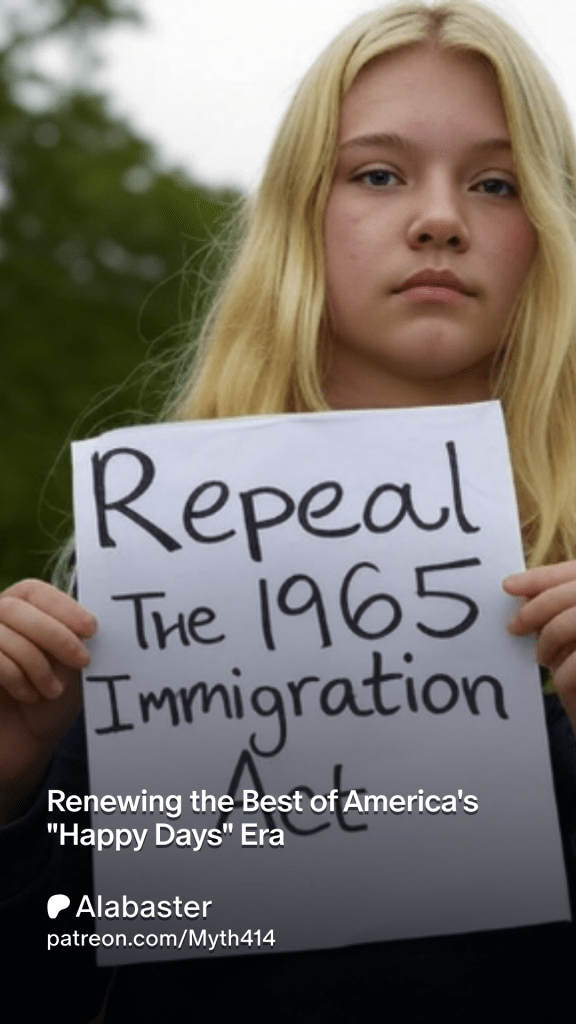
We need to embrace our American identity, including our heritage, our roots, and every bold, redeeming aspect of ourselves, and soundly reject the Jayapal/Sawant/Omar cults. Keep reading “Alabaster” for your regular, proud American analysis, digest, and spirit of isolationism. Let’s have a renewal, of sorts, of the ‘Happy Days’ era of America (the 1950s and early 1960s). God bless America.
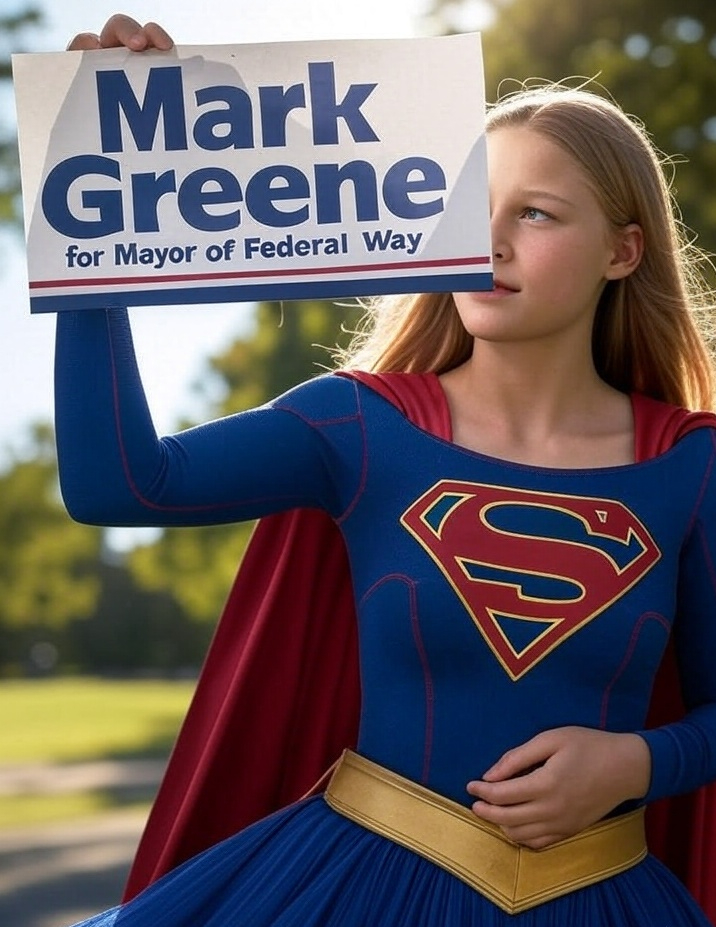
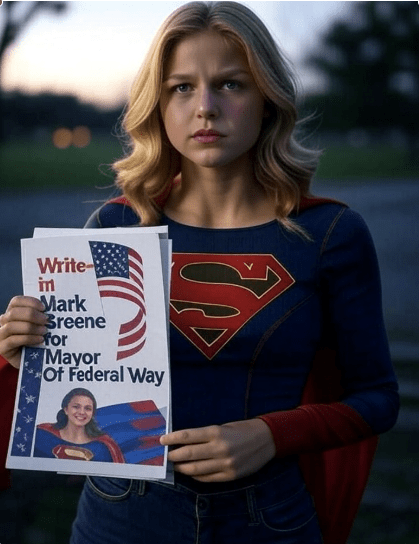
Note: For Federal Way, Washington residents, we recommend writing in the name of Mark Greene for Mayor of Federal Way. An active write-in campaign for the General Election only, and you still need to fill in the circle on the ballot, even after writing out the name.
PHOTO: Carrie Laramie, 18 , home-schooled, originally from Portland, Oregon and Mark’s right-hand partner.
Our committee president, Mark Greene, is a candidate for Mayor of Federal Way. He wrote the Washington State Public Disclosure Commission an email on May 31, 2025. He questioned why potential declared write-in candidates were not considered eligible for election by them, according to the language on their website. The site implies that candidates are not eligible without a formal write-in declaration. They are not even considered declared candidates in and of themselves. We believe that you do not even have to be a declared write-in candidate to win an election, according to the law. Winning is possible if your write-in votes outnumber everybody else’s votes. Being a declared write-in candidate helps with alleviating confusion. It accounts for misspellings of the candidate’s name. It seems to be in the candidate’s best interest. Still, it’s not a strict, legal necessity.
What’s the point of reiterating these points, you say? The point is that the Public Disclosure Commission cannot imply that candidates are not eligible for election on their ‘For the Voters & the Public’ website page. They cannot expect that kind of disparagement of write-in candidates or declared candidates to go unquestioned. When you sign up with them as a candidate, it apparently means you’re a ‘declared’ candidate. This is based on the logic of their stated legally mandated requirements of being a candidate. You need to report that fact to them. For the record, being a ‘declared candidate’ is different than being a ‘declared write-in candidate.’ You could technically be one without the other. Although, we believe all candidates for any public office in Washington must sign up with them (if there’s an exception to the rule, we’re not aware of it). This should be done within two weeks of becoming a candidate.
All of this is a long-winded way of saying something important. Anybody who signs up with the Public Disclosure Commission is eligible for election. This remains true unless that candidate informs them that they are no longer a candidate, thereby making a formal withdrawal of their candidacy. So, why would the P.D.C. have a website that implies differently! They could use an asterisk for candidates that simply are not on the ballot. That would at least be informative. It would also be factual. It’s counter-intuitive to use asterisks for candidates within the standard framework of elections. Especially when compared to those going, or potentially going, the write-in route.
Mark Greene is a write-in candidate for Mayor of Federal Way. He intends to make that a declared write-in candidacy.
F.W. Lifeline Mark Greene for Mayor is the name of his election committee.
The P.D.C. did not respond to the committee’s query on this subject but we’ll be okay without an answer…we’re eligible for election either way.
POST-SCRIPT:
P.D.C. finally responded after more than a week.
Good afternoon,
In response to your question about the green asterisks denoting ‘declared candidates’ and ‘candidates eligible for election’ on the PDC website, yes, these also include “declared” write-in candidates.
PDC candidacy forms submitted to us, in and of itself, do not necessarily mean ‘declared candidate’. A “declared” candidate files declarations of candidacy with election officials. Persons “register” with the PDC when, according to the disclosure law, they become a candidate by doing one of these things: accept a contribution or spend money for your campaign; reserve space or purchase advertising to promote your candidacy; authorize someone else to do any of these activities for you; state publicly that you are seeking office; or file a declaration of candidacy.
I hope this information is helpful.
Mark’s response to their (PDC’s) response: Thanks for the reply. It is new and kind of puzzling to me that registering with you (the PDC) is not necessarily the same thing as being a declared candidate…if I understood your reply well…so that explains why some candidates can apparently get away with filing a C-1 form but not file (an) F-1 form in a timely manner, if at all, because filing a C-1 form doesn’t necessarily mean you are a declared candidate, according to your email. Therefore, (an) F-1 form is not necessarily warranted at all until a candidate files a declaration with their election office or in some way advertises his candidacy, but merely registering with a C-1 form doesn’t automatically require a follow-up F-1 if this logic is to be followed.
F.W. Lifeline Mark Greene for Mayor Committee: We’re getting a headache trying to understand this election minutiae. So, apparently being a declared candidate and being ‘just a candidate’ can be two different things (who knew?) but how do you become ‘just a candidate’ without declaring that fact and at the same time indicating a bunch of legal requirements, like filing with the PDC.
Post-Script: Regarding the above statements by our committee, we are just ruminating publicly, donot follow our thought line about reporting requirements, necessarily. If you become a candidate (under PDC jurisdiction) at all, you should file both a C-1 form and an F-1 form within two weeks of your candidacy, no ifs, ands or buts.
We think a lot of the confusion we’re writing about is a matter of semantics and could be solved with better word choices. Like use the word ‘official’ for certain candidates instead of ‘declared’. ‘Declared’ has at least two different kinds of meanings, such as somebody could just stand up in front of a neighborhood group and say that they are running for Council. That would be a theoretical declaration but it doesn’t necessarily mean you’re a ‘declared candidate’ under PDC rules or jargon, apparently. ‘Official’, on the other hand, would mean that you made an oath or did some kind of paperwork with an election authority that certified your candidacy.
We knew that universities and colleges in the U.S. had a penchant for recruiting and signing up foreign students. This is especially true for the leftist and radical leftist ones. Nonetheless, we were slightly surprised to see the high percentages of foreign students at these institutions of higher learning. The percentages are often as high as 33 to 40 per cent, or even higher. In other words, one-third or more at a lot of them. President Donald Trump is right in criticizing these high numbers. His administration is trying to push back on it by revoking visas. They are also rolling back approvals in the first place. All of this is good. We thought the number of foreign students at these institutions was around 20 to 25 per cent. This isn’t good, either. The range is probably all over the map. Nevertheless, it’s generally too high.
The unusually big number of foreign students enrolled in universities and colleges in America has several problems. Like America is supposed to help Americans foremost and primarily…YOU THINK. For every slot that a college gives to foreigners, it means that many slots are not given to Americans. Americans should be given the first right to all slots…did we say “all”, yes we said ALL.
Alternatively, if colleges have a special educational need to invite a few foreign students, that happens to be truly exceptional, it must meet whatever the legal standard is or should be on the books. Additionally, if there are extra slots that our own citizens have decided not to fill; then, the colleges have a rare opportunity to have some of their international, so-called diversity slots filled. Right now, the ‘open borders’ policies of colleges (and that’s what it is, it’s just a different version of it) and America in general have already caused a great 5th Columnist Trojan Horse to settle in our nation. The former Biden Regime increased the 5th Columnist threat immensely, to put it mildly.
We won’t cover the details too broadly in this essay. This is just a little essay trying to be Paul Revere. It warns about the bordering-on-treasonous, or exactly treasonous, opening-of-America-to-‘anybody’ policy. This threat is posed by unpatriotic, unamerican, globalist elites. More than a few of them are foreign themselves, or not that far from it. Surprise, surprise, surprise.
 (100% Sun-Light News)